WA’s A$20m clean-energy planning rule starts today
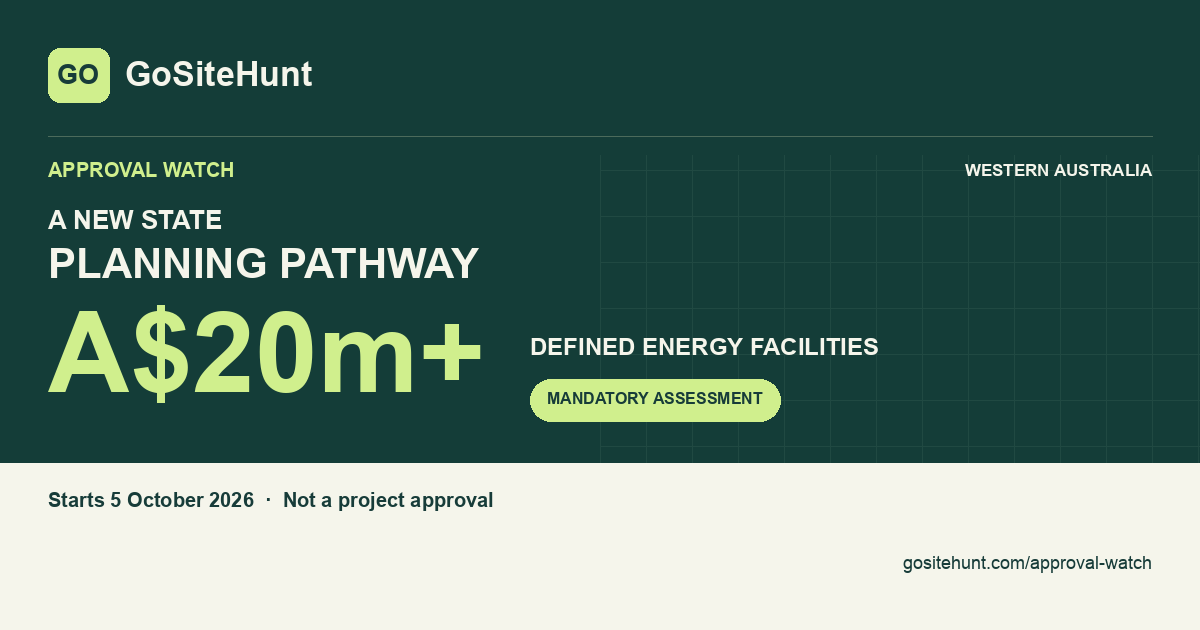
From 5 October, specified energy and industrial proposals outside the Swan Valley move to a mandatory State pathway. Existing applications are protected; no project is approved by the rule itself.
Key takeaways
- Check the statutory facility definitions, estimated cost and planning-scheme area before selecting a pathway.
- The mandatory State route is a decision process, not a planning approval.
- Applications made before 5 October remain on the pathway selected when lodged.
A new mandatory route begins for specified large facilities
A Western Australian planning rule taking effect today changes who decides certain major energy proposals. The Planning and Development (Significant Development) Amendment Regulations 2026 were published on 5 August; regulation 5A, the operative classification, starts on 5 October 2026. It makes a development a mandatory significant development where it is outside an area covered by the Swan Valley Planning Scheme, includes one or more of the defined relevant facilities, and the estimated cost of those facility or facilities is at least A$20 million.
The list is specific: ammonia production facilities, battery facilities, hydrogen production facilities, renewable energy facilities and transmission systems. It is not a rule that automatically sends every project with a large overall budget to the State. The statutory test refers to the relevant facility or facilities and excludes the Swan Valley Planning Scheme area. Applicants should check the definitions and mapped scheme boundary against the actual scope and cost estimate.
The State assesses and decides; local input and public consultation continue
Qualifying applications are lodged with the Significant Development Assessment Unit within the Department of Planning, Lands and Heritage. The unit assesses the application and recommends an outcome; the Western Australian Planning Commission makes the decision. The State Referral Coordination Unit coordinates advice from State agencies. The Department says mandatory pre-lodgement engagement applies, local governments are formally consulted and public submissions remain part of the process.
The published statutory assessment timeframe is 120 days unless otherwise agreed with the applicant. That is a process timeframe, not a promise of a decision by a particular date or of approval. The Renewable Energy Planning Code is still a draft; until finalised and incorporated into local planning schemes, applications are assessed against the current planning framework, with applicants also asked to address the draft code.
Transition rules keep earlier applications on their chosen route
An application made before 5 October is not affected by the new regulation. The Department says applications already lodged with a local government or Development Assessment Panel cannot simply be transferred into Part 11B. A proponent seeking a WAPC determination would need to withdraw and lodge a new application, paying the applicable fee. The meaning of “lodged” depends on submitting the required form, fee, plans and supporting information.
For proposals below A$20 million, existing pathways remain relevant. Some proposals outside Perth, Peel and the Swan Valley may still be eligible to enter the Part 11B pathway at A$5 million or more; others may go to a Development Assessment Panel or local government, depending on the scheme and eligibility. Check the current threshold and pathway for the specific location.
GoSiteHunt analysis: treat the pathway as a site-screening variable
For an early feasibility screen, record the decision pathway beside the project type, location and estimated facility cost. Map the parcel against the applicable planning scheme, test whether the statutory facility definitions fit, and confirm whether a complete application was lodged before the commencement date. Those checks can change the assessment authority, process timetable and fee assumptions.
Keep the qualification visible in any project note: this regulation creates a mandatory State assessment route for a defined class; it does not grant planning permission, settle environmental approvals, confirm grid access or demonstrate commercial viability. Any actual project still needs its own application and decision record. The implementation details should be checked against the issued regulation and the department’s current guidance before relying on them.
Read the sources
Planning decision: . Source check: . Follow the original records for conditions, supporting documents and subsequent changes.
- Planning and Development (Significant Development) Amendment Regulations 2026, SL 2026/161 — commencement, regulation 5A and transition ↗planning.wa.gov.au
- WA Department of Planning, Lands and Heritage — Renewable Energy Development Application Decision-Making, updated 12 August 2026 ↗planning.wa.gov.au
- WA Department of Planning, Lands and Heritage — Part 11B Significant Development Pathway, eligibility and process ↗planning.wa.gov.au
About this story. The decision facts above come from the named sources. Sections labelled GoSiteHunt analysis are our interpretation. A permission is specific to its site and conditions; it does not establish what another property can build or confirm that construction has begun.
Found a material update or correction? Contact GoSiteHunt with the article link and source.